
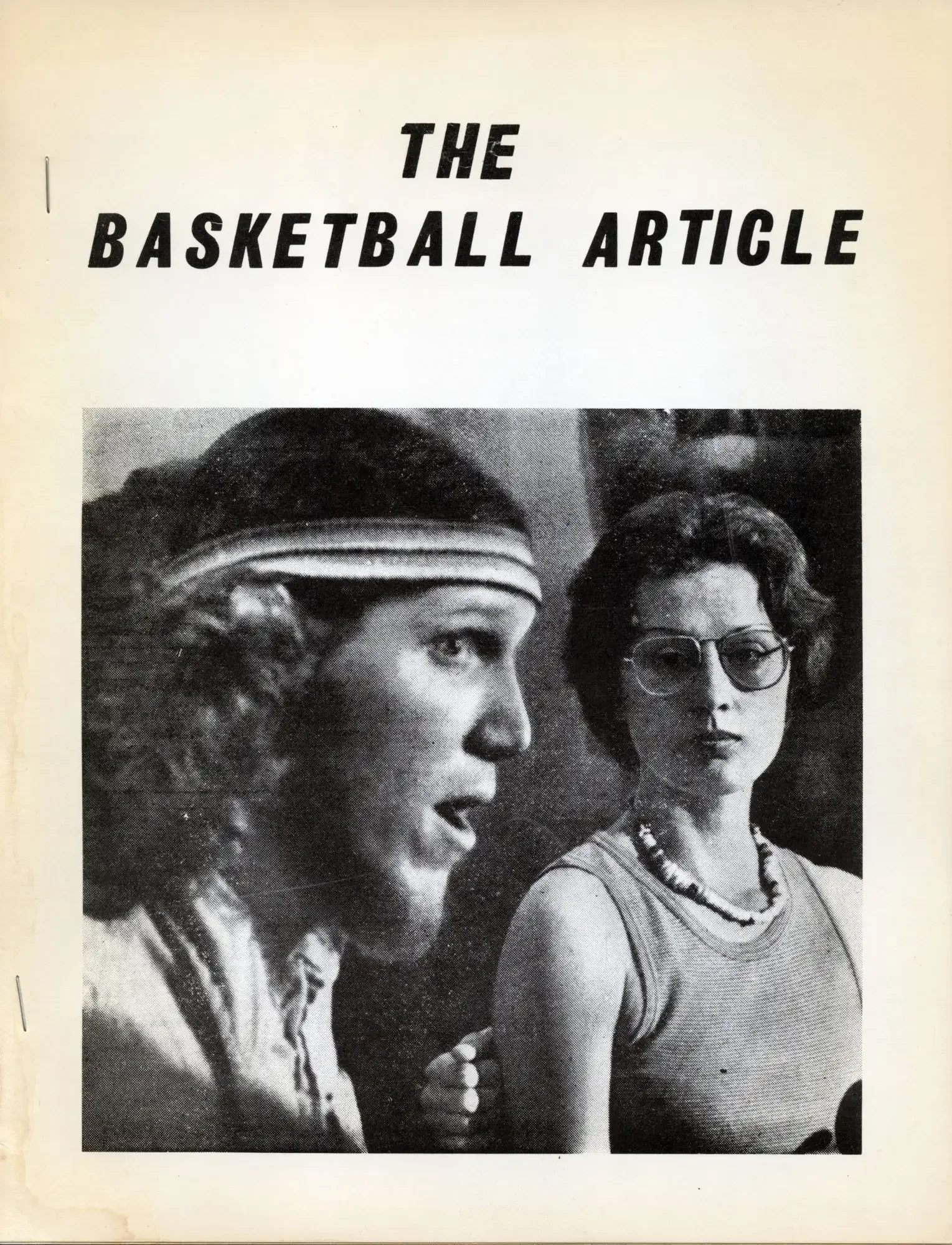
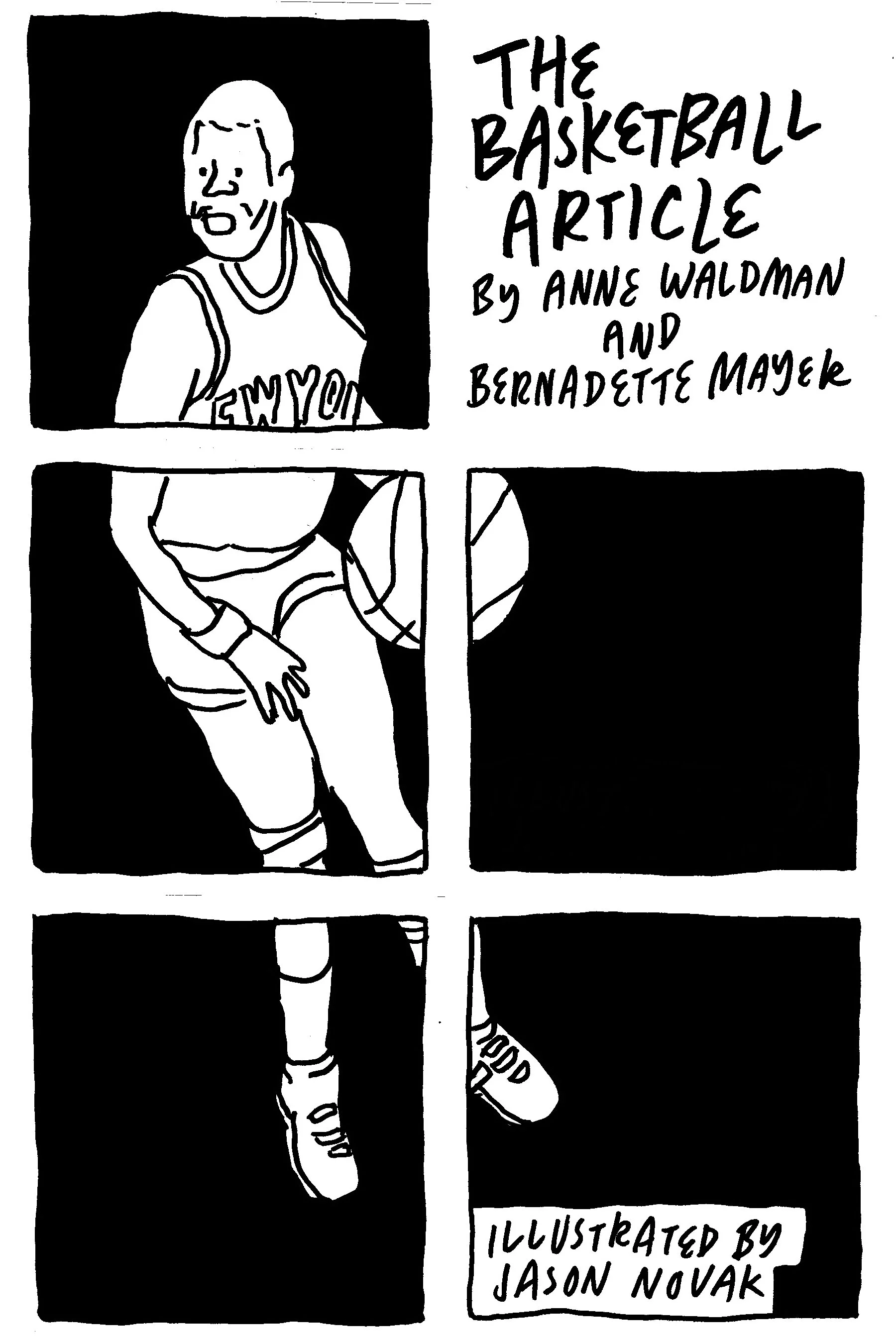
The Basketball Article
Anne Waldman and Bernadette Mayer
1st edition: 1975
2nd edition: 1978
Re-released in 2020
Angel Hair Books
A purely prophetic work in the tradition of social realism, THE BASKETBALL ARTICLE was rejected by publishers for being too technical (Oui Magazine), not technical enough (Village Voice), and fragmented. Some editors considered it “a minor masterpiece,” while others “couldn’t tell what the hell was going on” in it. Eventually an edition of 100 was printed by Angel Hair Books. Original copies are extremely rare and sought-after.
"Bernadette Mayer and I actually got a 'kill fee' from OUI magazine for The Basketball Article, our first foray (and last?) into the interstices of power-journalism. I remember we wore scarves and berets and long boots for the games, looking decidedly bohemian as we sat taking notes at the edge of the ballcourt. Bernadette always carried along a copy of Shakespeare's Sonnets."
—Anne Waldman, The Angel Hair Anthology, p. 605
Is there a school for sports announcers? They should all have to read this. The note is such an amazing performance of the intricacies and tensions of how the female poets of the “second generation” New York school fucked with and played against the warp and mess of gender expectations in the 70s. The whole book takes those issues of male dominance and exposes them in the scene and celebrity of basketball. Two women conceiving together in spite of the jocks, how technical mastery or a failure to master (mister) is noticed/received/reviled, what it means to be seen and given access (publicity/privaticity), to have or not have titles, to be whole or in pieces, what it means to (mis)represent an ideology, to be rejected/accepted/handled/owned/duplicated, the clout of expertise and the disregard of being inept, the prophetic in the easily reproduced and popularly reported. “We never got into the locker room.” To be a charlatan, to be marginal, and to write out of and through the thrill and profanity of those deficiencies not as deficiencies but as channels of renewal. Joyful, flamboyant little aporias as the clock ticks down.
—Nick Sturm
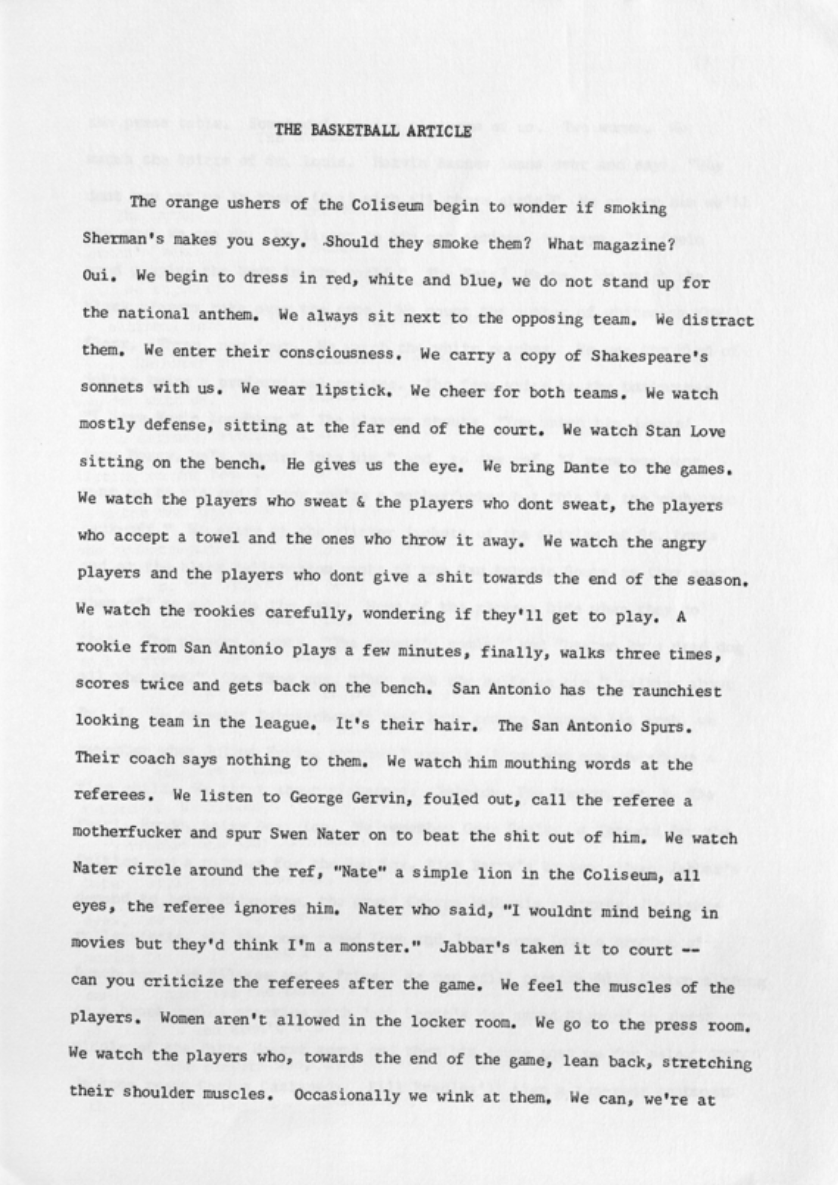
In 1974, Bernadette Mayer and Anne Waldman came up with the idea of writing an artistic, conceptual piece of sports writing. In doing so, they brought a unique, often silenced perspective on sports: the woman’s perspective. In The Basketball Article, Mayer and Waldman threw down their gauntlet in the traditionally male sphere of basketball. The article records their experiences attending basketball games, talking with players and playing basketball in parks around New York City.
The article was confusing to publishers: a non-technical article about basketball, written by women. The article challenges the stereotypes of what a sports article should look like. While Mayer and Waldman mention statistics, they don’t obsess over them. Highlight reel plays are glossed over and forgotten. Mayer and Waldman even make an effort to be confusing and to stand out.
“We always sit next to the opposing team. We distract them. We enter their consciousness. We carry a copy of Shakespeare’s sonnets with us. We wear lipstick. We cheer for both teams.”
Professional sports is intrinsically objectifying. Fans care about the performance of the athletes on the field or court, not their personal lives and feelings. Players are treated like pawns by team owners and general managers, shipped around the country and traded in search of excess value. Professional sport is also sexualizing by nature. Men at the peak of their athleticism are scrutinized for the physics attributes and abilities. However, this sexualization and objectification is taboo. Men are afraid of this sexualization due to homophobia and the fear of appearing homosexual. Mayer and Waldman do not shy away from this sexual and non-sexual objectification. They take this sexual objectification head-on, repeatedly noting physical attributes of players’ bodies. Despite this, they also dive deeper into the personalities of the players than any “normal” sports article would. When they talk with Oscar Robertson and Dave DeBusschere, they don’t discuss statistics and accomplishments, but everything from hope and dreams to fears and family.